This blog exists to support liberatory collectivist activism that seeks to uproot patriarchy, colonialism, and capitalism. It also acts to center the experiences, theories, and agendas of radical and feminist women of color.
Race, like gender, like sexuality, like economic class, all exist as socially real phenomena, lived complexly while organised and politically constructed to appear to be predominantly and irredeemably natural and inevitable. There is, in my view, increasingly less and less recognition that each category necessarily includes all the behaviors which manifest each. And that among these political behaviors are some which might seem relatively benign, but are linked to those others which are more overtly unjust and inhumane. To see how the apparently benign behaviors are tied to those that are terroristic ought to lead us perpetually and perennially toward developing approaches and strategies for stopping the madness. Perspectives which clarify rather than cloud the foundational, destructive dimensions of each hierarchical caste system, must congeal through the process of arresting, obstructing, and halting the forces used to maintain each system of power: white supremacy, male supremacy, and heterosexism. The theories are borne and honed in the practice of the resistance and rebellion, not prior to it.
Post-modernism, in the wrong hands, becomes a tool for obfuscating the political and terroristic social nature of each of the aforementioned hierarchies. Social norms and roles work to make it appear these play as they should. Whether through media propaganda or military might, we are routinely led back to the fundamental belief that whites ought to be positioned over and against people of color structurally, so that white supremacist ideology and its practice of oppression keeps whites better off, living off the bodies of those who are not white. What liberals misunderstand is that hateful ideologies alone don't oppression make. Hate, or callousness, or cruelty, or selfishness, must be institutionalised and backed by major systems of force in order to be collectively dangerous. The force of ideology isn't found primarily in ideas, but in terroristic and brutal actions. The idea of Black Power, for example, offers no significant threat to white power as long as whiteness rides a history and present of anti-Black slavery, lynchings, apartheid policies, and gross discrimination. The same with gender, sexuality, and economic class. The idea of feminism isn't substantively threatening to male supremacist power as long as misogyny is normative and rape is inevitable. Men who disparage feminists do so not because feminists will harm men, but because men want to ensure they can continue to harm women, for profit, pleasure, and significant privilege.
When the suffering of women who are terrorised and otherwise harmed by male supremacists is seen as psychological and personal, not structurally political and social, it may be diagnosed as a dysfunctional aspect of the oppressed not adjusting properly to positions of mandatory servitude. Refusal to agree to the terms of one's own subjugation is cause not only for being harmed, but also incarcerated and institutionalised. Denial of the level of threat, displacement of rage onto those similarly oppressed are among two strategies for surviving while the cattle cars make their way to the gates of Auschwitz. Assimilation into or acquiescence within systems of destruction can only enable more destruction. And those with the most structural power are the most responsible for stopping the trains on their tracks, then dismantling the tracks and the train cars, as well as concentration camps and the SS.
Post-modern theories were developed in Europe, mostly by anti-status quo white men, to assist in toppling oppressive regimes--in thought and beyond thought in the very bloody social world. They were not intended to be used to reinforce and maintain the status quo. But, as with most theories exposing the vulnerabilities of the most powerful, or the lies that prop the leaders up, post-modernism, largely, has been misappropriated by the Academy, along with post-structuralism, to confuse the issues at hand. Where "woman" was, for a time, defined by some feminists as the category of people assigned female at birth, raised as girls, and treated as women as adults, post-modernism in sexuality and gender studies assumes that there is no such discrete category. This effectively invisibilises the force and terror used to create it as such. People who are initially indentified as female, are raised to be feminised because that is seen to be appropriate-while-compulsory, and who are treated as feminised adults by men, sexually and socially, are a particular oppressed group in a male supremacist system. To pretend that group isn't specific while diverse, is to ignore social-political reality.
Once we stray from the idea that gender is political into the belief that gender is fluid, flexible, and malleable, we drift away from the urgency to radically challenge gender's right to exist in the first place. To make race only into "ethnic difference" is to pretend white supremacy doesn't construct "race", including especially the white one.
We are living in dangerous times. Theories that once held value in communities of resistance to the status quo are threatened by other theories which effectively mess with the project of dismantling and radically transforming corporate racist atrocious patriarchy (CRAP) by back-burnering actions aimed at exposing and eliminating the terror and force necessary for CRAP to exist.
If race or gender is re-naturalised as one of many differences in the human species, seen only as too constrictive due to their not being enough categories, we are left with white and male supremacy as ruling systema of oppression. The same is true of sexuality and economic class. More presence of more races, genders, sexualities, and classes inside CRAP effectively avoids dealing with the issue that one of them, "non-white" or "woman" or "non-heterosexual" or "poor" is required to be submissive and subservient to another group of people, called "white people", "men", "heterosexuals", and "the wealthy".
One of the reasons I have, in some posts, questioned why bisexuality is contained in the acronym of the social group working to end heterosexism is because it doesn't come with a political agenda other than to fight for its right to sit at the table that dead lesbian and gay youth rot under. I support a bisexual agenda to dismantle heteropatriarchy. I simply haven't seen one materialise.
I question the usefulness, even, of perpetuating the term "gay" if all it means politically is a category of feminised men striving to not be seen and treated as if feminised while allowing or encouraging women to be treated as such. Better I call myself pro-feminist, to locate my relationship to opposition to masculinist/patriarchal force and terrorism, including that aimed at gay men. But what I call myself matters less that two other things: how I am treated--statused or stigmatised, why that is the case, and what I am doing in concert with other oppressed people to end these conditions of some groups being privileged while others are persecuted.
If we accept, without organised resistance and as inevitable, the systems which necessarily destroy some of us, we insure the tally of traumatised and murdered oppressed people will go higher and higher.
The way to stop deaths by warfare is to end the wars. We don't collectively work to stop warfare if we are socialised to consider it heroic, erotic, or profitable on any level. There are many wars being waged. Let's not forget about these: men's against women; whites against people of color; straights against lesbians and gays; and the rich against the poor. The oppressed seeking membership in the clubs of the oppressor don't accomplish the dismantling necessary to end the bloodshed. Nor do efforts of the oppressor seeking to join the ranks of the oppressed.
We either collectively challenge and end the terrorism or we don't. To turn it into entertainment such as via video games, into sex such as via pornography, into increasingly complex sociology via an academic version of postmodern theory, or or into official status by honoring and celebrating those who murder people abroad, such as in the U.S. wars in Afghanistan and Iraq, we allow the terrorism to thrive. We make the trauma and horror that comes with this terrorism into something we need to figure out how to endure endlessly, not end by any means necessary. Once the degradation and subjugation of the oppressed is revered as normal by the systemically privileged controlling groups, we are left with the illusion that hierarchies are merely differences, not expressions of dominance.
When I challenge men to take up the project of ending the rape of women by men, or the incesting of girls by men and boys, what I get back is either resignation that such a project is doomed to fail, a complaint that I'm ignoring the ways boys and men are also hurt in society, or the argument that it isn't a worthwhile project relative to others that are seemingly more important. To understand how rape is tied not only to patriarchy, but also to white supremacy, heterosexism, and capitalism, is to begin to make the case that de-prioritising an agenda and organised practice of ending rape is keeping all those other systems of force in place.
Once you see who is raped in society and care about the experiences and feelings of raped people as much as those of anyone else, you might also see how white supremacy, male supremacy, heterosexism, and capitalism operate together terroristically.
photograph of Ruchira Gupta of Apne Aap is from here
It annoys the shit out of me when non-Third World and non-impoverished people propose that the solution to things like prostitution abuse is "better parenting" as if incest and battery of children, and lesbophobia, homophobia, and transphobia in families, aren't big ol' glaring factors in why many children in the West/North run away from home. And as if poor parents anywhere in the world are, intrinsically, bad parents. As if pimps, procurers, war-mongers, drug-dealers, corporate polluters, capitalistic greedy bastards, selfish, callous, and inhumane jerks, and other predators aren't THE problem with regard to children being out in the street. There are so many obnoxious "First World" assumptions about life and complete ignorance about realities that some of us in the U.S. and the Global Northwest simply do not face--and that some of us in North America, for example, DO face but are not reported about because the rich white het male-controlled media doesn't give a flying fuck about poor children and women of color on or beyond this continent.
For those of us living in great denial with equally great arrogance and significant structural and social supports, we assume that everyone has the same options, the same freedoms, and the same levels of privilege and entitlement, to do what we want, including to work in sexxxism industries, or not. So the line between "choosing to work there" and "being enslaved there" is made blurry only by those who have enough privilege and/or denial to believe everyone "chooses to work there".
So let's be clear: if you're not living in abject poverty, earning less than three dollars a day income, shut the fuck up about what bad parents some parents are for letting their children out into the street to be picked up by pimps. Because, really, you have no fucking idea what's going on. None at all. You have no idea how pimps are, necessarily, smooth operators, lying bastards, who approach poor parents sometimes and pretend to represent educational institutions in the West/North and propose that their child will actually thrive in the Global North/West if only they can get to a good academic institution located in that far off place.
Maybe a parent (inside or beyond North America, South Asia, Eastern Europe, or Central America) wants something likes this for their child, something other than abject poverty and hunger. Maybe the pimp is very good at what he does: lying and stealing, including stealing children from parents through deception and the manipulation of powerful love so many parents have for their own children--a love so strong one would be willing to not see one's own child for years just to know s/he has a better life as defined and delineated by the pimp. And, then, most tragically, the pimp brings the child into a life far worse than any imagined hell. And the parents are betrayed and may not get to know this for some time. So, that's not bad parenting, to be clear. That's called "effective pimping and trafficking and slaving". Just for the record.
Please click on the title of the article to link back to the source website and watch the short video that goes with the text if it doesn't play below.
Campaigners in India are demanding that authorities step-up efforts to battle what has become a real plague for the country - sex-trafficking.
With little value placed on girls from poor families, it is thought more than a quarter of a million women are trafficked in India each year. Some are as young as nine, and come from the rural areas of neighboring Nepal.
The parents of the victims do not always realize what the world outside their home is like, says Ruchira Gupta, the president of an anti-trafficking NGO called Apne Aap (which means self-help in Hindi).
”The parents may know a little bit about what Bombay [Mumbai] is if there is television in the village. To them Bombay represents a lifestyle rather than a brothel, and the difference between hunger and food and a job,” she explains.
It is easy to cross the border between India and Nepal. There are well established routes for trafficking.
“India is the epicenter of the sex trafficking industry right now in the world. The reason is that there is low enforcement of laws against traffickers, pimps and johns,” says Ruchira Gupta.
In the northern state of Bihar, rescue groups keep an eye on the trains passing through.
”It's not easy,” confesses Sita, one of the social workers. “When we ask youngsters where they are going, they say they are going to study. If a girl is traveling with a boy, she says he is her brother. But when we demand their identity cards, we see they aren't related.”
“We have no work in our village. I have two young children and when I was promised a job in Mumbai, I decided to take up the offer,” one of the rescued women says.
It is an easy to convince young girls in a village hundreds of kilometers away that they can make it big in Mumbai.
“Girls are misled by people offering them jobs in big cities,” says Bihar Police Inspector A.K. Gupta. “Some are convinced that they can be a part of a dance group, and are conned into coming to India.”
Taking into account the gravity and the sheer size of the problem, campaigners want to see villagers in Nepal given more warnings of the dangers, and the police more active in clamping down on traffickers.
Have you noticed that the only harm that happens when WikiLeaks releases secret information about the U.S. government, is to the image of the U.S. government and its military? How, for example, the top secret documents repeatedly show us how corrupt they are, how much they act in grossly selfish, callous, and cruel ways--like using torture techniques that violate international law--but they are never brought to justice? Or how they rape and murder more than they say they do? Or how they can't be honest with the U.S. people about the most basic things--like why they are at war in various parts of the world and against poor and immigrant people? Or how they are a terroristic organisation--terrorising all women, terrorising men of color, and yet government and military officials cannot and will not call what they do and what they are exactly that?
Below is an article by Z writer Bill Fletcher on Race, Xenophobia, and Migration. However, first we’d like to bring your attention to breaking news.
On Friday October 22nd WikiLeaks released the "Iraq War Logs," in what they are calling “the largest classified military leak in history” with 391,832 reports. The logs document the war and occupation in Iraq between 2004-2009 “as told by soldiers in the United States Army.” ZNet is featuring our coverage of this event and so far we have a number of items on the site. These include articles and video by WikiLeaks founder Julian Assange, Josh Stieber who was deployed in Iraq, and whose Infantry Company was shown in the Wikileaks’ “Collateral Murder” video released April this year, and finally, by legendary whistleblower Daniel Ellsberg, who leaked the secret history of the Vietnam War in 1971.
Here are a few items that we have published so far:
We hope you find these useful. Please check the site for more news and analysis over the coming days.
If you are a free member we hope you will consider becoming a sustainer. If you are already a sustainer, we hope you will consider increasing your donation.
From October 8-11 in Quito, Ecuador, the 4th World Social Forum on Migration was held. Hundreds of activists and scholars from around the world participated in some of the most interesting plenary sessions and workshops of any conference I have attended.
"The conference was an eye-opening experience. Migration was examined on various levels, including global economic, political, military and environmental factors, all of which influence migration. The International Labor Organization estimates that at least 83 million people are currently migrating, a figure that is bound to grow for many reasons, particularly climate change. Yet in the face of this mass migration of human beings, there are political forces that have taken advantage of the fear that is often produced through demographic changes in order to advance right-wing, irrationalist and xenophobic politics. This, too, was addressed at the conference.
"I was asked to deliver a key note speech to one of the plenary sessions that addressed discrimination and xenophobia. The following is the text of the remarks that I delivered. I hope that you find them of interest and use."
--Bill Fletcher, Jr.
~~~
Let me begin by thanking the organizers for inviting me to engage in this discussion.
The nature of the remarks I am to offer—which focus on the issues of race/racism, xenophobia and migration—are more than enough for a multiple week class. Unfortunately, or perhaps fortunately for you, I do not have multiple weeks to deliver it. So, in the next fifteen minutes my hope is to offer an overview of the relationship of these issues and end with some suggestions regarding a manner to rethink global solidarity in the context of migration in the 21st century.
We must begin by establishing, without any ambiguity, that “race” is not a biological or genetic category, but is a political construction. The origin of ALL of humanity is to be found in southern Africa, so in that sense, all of humanity is African.
Yet the notion of race, and the corresponding practice and theory of racism is very real. Prior to both the so-called “Reconquista” in Spain with the Catholicization of Iberia and the purge of the Moors and the Jews in the 15th century, as well as the English occupation and colonization of Ireland in the 16th century, “race,” as we have come to know it, did not exist on planet Earth. While there were certainly religious, tribal, ethnic and imperial conflicts, this was transformed over the course of the end of the 15th century and throughout the 16th and 17th centuries. Race came to be associated with so-called inferior and superior peoples, and fundamentally with the occupation of lands and the displacement of populations. Eventually, this came to be associated with skin color, but it is worth noting that in the beginning race did not depend on skin color, with Irish Catholics and Spanish Jews being a case in point. This overall process of racial construction was linked with the development of capitalism and in that context, the notion of race must be understood as an ideological and institutional mechanism for both the suppression of specific populations in perpetuity, as well as the introduction of social control over the working masses as a whole, be they of the suppressed/oppressed population or of the suppressor/oppressor population.
In Latin America, the art form and classification code called the castas, along with the introduction in both North and South America of slavery for life for specific populations—Africans—and marginalization and genocide perpetrated others—Indigenous—had nothing to do with science generally or genetics specifically. Rather, it became a means to divide up populations, turning them against one another through the associated system of racial privileges that tended to be meted out according to how close someone got to being supposedly pure white. “White” was always the reference point for the dominant bloc, even though this did not in any way mean that everyone who was designated by the ruling classes to be “white” was automatically part of the ruling classes. It has also been the case that who is and is not considered white in a specific society is not always self-evident. A classic example from US history in the early 20th century was the debate over whether Armenians were to be considered “white” or not.
In sum, the construction of race was linked, from the beginning, to the rise of capitalism and later imperialism. It was not an add-on or a device that was to be used and thrown away at a whim.
The second piece that is important to grasp about race and migration is that the current global wave of migration, which the International Labor Organization (ILO) estimates to be more than 86 million, is fundamentally different from earlier waves during the history of capitalism, i.e., those from the 1500s through the early 1900s. In the waves of migrations that began with the invasion of the Western Hemisphere and the colonization of other parts of what we reference today as the global South, the migrating populations were part of the process of colonization and, as in the cases of the USA, Canada, Australia, and South Africa, to name just four locales, the establishment of formal settler states. These migrating populations, irrespective of whether they were persecuted in their European countries of origin, served as part of a process in the construction of colonial and settler states. Even when they engaged in wars of independence with their European colonial sponsors, these were struggles that were not truly emancipatory, but were struggles to redefine the terms of a particular relationship. To put it another way, most of the independence struggles represented a break with a colonial power—and a renegotiation of the relationship—but not a break with the key social and economic institutions, e.g., slavery in the Western Hemisphere; the Latifundia in Latin America, that were hallmarks of the colonial period. As such, the native populations were never true allies with the insurgents, but were, at best, allies of convenience (example: Native Americans used by both sides in the French and Indian Wars 1754-1763).
It should be noted that there were other migration patterns that did not originate in Europe. Migration from China and Japan to the Western Hemisphere in the mid to late 19th century, for instance, had a different character and particularly in the case of the migration of these Asian populations to the USA, there was intense hostility that was visited upon Asian migrants, a hostility that has lasted for generations. This is worth noting since the European migrants, even when experiencing a hostile reception by prior European migrants, were generally absorbed into the “white bloc” after their ‘credentials’ as white people were established. Asian migrants in the 19th and early through mid-20th centuries faced a very different challenge since they were not accepted into a white bloc. They were placed, depending on the country or territory to which they migrated, into a racial hierarchy but they were not considered white people.
The character of migrations began to change in the early 1900s when populations from colonies proceeded to relocate to the imperial centers. The migration patterns that we are witnessing today are a continuation and acceleration of this process. In the absence of self-determination and with the deformed economic and political structures imposed on colonial and semi-colonial territories, populations began to shift. Separately, there were population shifts between and among colonial and semi-colonial countries. The migration of Haitians to the Dominican Republic that began in the 19th century, for instance, is just such an example of the latter, and one that reminds us of the manner in which xenophobia can take on genocidal proportions when a so-called native population is manipulated through fear. Specifically, race was constructed in such a way in the Dominican Republic that there was a generalized denial of the African roots of most of the population and a distain for anyone described as being “black.” The dictator Rafael Trujillo took advantage of this situation to move an anti-Haitian pogrom in 1937 in which more than 20,000 Haitians were murdered, having been blamed by Trujillo as having been the source of the Dominican Republic’s many problems.
Current waves of migration, then, have as their source both a continuation of these factors, plus additional factors, including but not limited to wars, neo-liberal globalization, imperial foreign policies and climate change. Time does not permit me to examine each of these. In this situation, however, we must note, that the ‘racialization’ of migrants has taken on a particular significance.
At the global scale such racialization is found in the broad characterization of European/white vs. non-European/non-white. What this means, particularly in the post-World War II context, is that the “problem” of migration has usually been associated not with the general question of migrants and refugees, but the specific question of the shifting of non-white populations away from their homes of origin to the imperial metropole (usually meaning to the country that was the historical imperial/colonial dominationist force over their particular oppressed nation/territory/people). The non-white migrant has been presented as the ‘evil’ or the problem by the so-called “nativist” forces in the global North on a racial basis. As the theorist Etienne Balibar has pointed out, however, this racial construction is a bit different from traditional racial notions since it does not OVERTLY presume superiority/inferiority (certainly on an alleged genetic basis) but rather articulates an ‘other-ness’ based on cultural incompatibility.
To explain this point for a moment, let us take an example from the United States. As you know, the issue of illegal or undocumented migration has been a major watchword for the political Right since at least the 1970s. In the USA, the face of the undocumented migrant is, in the popular imagination, not color neutral but is brown and black. It is largely—though not exclusively—the face of the Latino despite the fact that undocumented migration has never been restricted to this group. In the 1980s and early 1990s there was significant Irish migration to the USA, an important percentage of which was undocumented. Yet Irish migration to the USA during that period was never defined by right-wing or mainstream sources as being problematic. For all intents and purposes it was ignored. Documented AND undocumented migration from Haiti, the Dominican Republic and Mexico during that same period, however, was defined as being a problem because the unspoken message was that the Irish can be absorbed into the dominant white bloc in the USA, whereas the Haitians, Dominicans and Mexicans represent an “OTHER” population that is culturally incompatible.
The racialization of migrants, however, is not something that is limited to conflicts in and with the global North. The xenophobic response to migrants in parts of the global South, be it the genocide against Haitians in the 1930s under the Trujillo dictatorship in the Dominican Republic or the more recent attacks on migrants in South Africa by mobs, points to forces largely driven by limited—and often declining—resources that results in toxic competition between populations. This competition becomes racialized where the migrants are portrayed as the force that is incompatible with the needs and existence of the dominant population. They become the “Alien,” so to speak, both literally—that is, in terms of the law—and figuratively—that is, in terms of the popular imagination. This competition for resources, we must note, is not something that exists in the abstract but is a phenomenon related to the rise of neo-liberal globalization and the dramatic polarization of wealth and resources we have witnessed on a world scale. When we have a situation, for instance, where 225 individuals have the accumulated wealth of the bottom 47% of the world’s population it becomes clear that those at the bottom will be struggling to make do with what is left to them by those who have accumulated so much.
With regard the question of migration and the dialectic between the global North and the global South, we must understand that the political Right plays upon what a US Hip Hop/Rap group called “Public Enemy” described once as a fear of a Black planet. When I use the term “Black” here I mean it more in the manner that many of us used it in the 1960s and 1970s, that is a term referencing not just people of more recent African origin but people from the former colonies and semi-colonies. Changing global demographics along with changing economics and politics have become a source of fear and insecurity for much of the global North, specifically, for the so-called white populations. The fundamental source of this insecurity actually is rooted in both the weakening of traditional imperialist relationships along with the rise of neo-liberal globalization and its transformation of both domestic and international conditions for working people. To put it another way, as the living standard for the working population in the global North declines due to the neo-liberal transformation—including the transference of wealth to the rich—the ‘spatial’ violations that are the result of migration come to represent more of a perceived threat to that same population. That “threat” may be in terms of competition for employment in certain sectors, but more often than not it is a psychological threat in which the working populations of the global North come to recognize that imperialism’s impact can no longer be perceived as being solely an external matter but is also manifested internally…that is, the security that once existed is now long-gone.
What are some of the implications of this analysis? Let me suggest the following.
1. A progressive response to migration cannot be grounded on abstract moral principles but must be grounded in an understanding of the historic relationship between the migrating population and the target of migration: The absence of an analysis that provides a context inevitably leads to failure. If one cannot explain the historical roots as to why a migration pattern is unfolding and the relationship of the policies of the migration target to the migrating population, then the migration may not make any sense or can be perceived as the equivalent of an invasion.
2. The destruction of lands, nations and peoples by imperialism, and its current incarnation as neo-liberal globalization is resulting in unprecedented population shifts: The impact of imperialism on land use, climate change, ethnic rivalries, etc., is leading to increasing competition for resources as well as population shifts. In this environment right-wing ideologies, grounded in a racialization of other populations, has advanced in both the global North and global South with the objective of excluding or marginalizing migrant populations, and in some cases, exterminating them altogether.
3. Racialization, as a process, is not only a matter of the perception of the migrating population by the ‘native’ population but also the manner through which the migrating population perceives dynamics within migrating target nation: This particular point is one that could and should be the topic of an entire discussion. The migrating population does not migrate with a blank consciousness, particularly on matters of race. It travels to the target nation with a racial consciousness that is shaped by the ideologies, histories and experiences from the home country. It is also shaped by the perceptions of the racial hierarchy in the target country. Thus, and by way of example, Latinos migrating to the USA from the Dominican Republic, are shaped by the historical antipathy between the Dominican Republic and Haiti; the bizarre racial denial and oppression that was perpetrated by the Trujillo regime; as well as understanding of how white supremacy operates in the USA, including but not limited to which populations have what standing in the US imperial/racial hierarchy.
4. A radical, anti-racist practice must be introduced in order to build solidarity and respond to anti-immigrant and xenophobic ideologies and practices: The racialization of current migration has several objectives. One is the creation of a permanent, marginal, powerless and subordinate working stratum. This is summarized in the notion that migrant workers will do work that ‘native’ workers avoid. The other aspect of the racialization is exactly the opposite, that is, the use of the “Other” as a way of creating a renewal of the dominant white bloc and the uniting behind a right-wing populist agenda. Right-wing populism can sometimes be confused for progressive, popular-democratic politics, if one avoids race. Right-wing populism often seizes on language from the Left in order to strengthen its base among working people from the ‘native’ population. To break this alignment, the racist nature of right-wing populism must be unpacked and exposed and a politics advanced that focuses on the development of an alternative, progressive bloc.
The struggle for justice for migrant workers is directly connected to the struggle against neo-liberal globalization. The destruction of Earth’s resources and the massive accumulation of wealth by a minority of the planet to the disadvantage of the majority, means that billions find themselves in a struggle for survival. One option has become migration, but rather than migration being accepted as the reality of a modern economy, it has brought with it demonization of those who migrate, covert exploitation of the migrant, and the use of the migrant in fundamentally racist ways to serve as scapegoat for the economic injustice being felt by so many.
The struggle for justice for the migrant worker is inextricably connected to the fight for racial justice, and, indeed, the fight for broader social justice. This struggle must be integrated into our various battles and not placed to one side as one additional issue on a long list of issues.
If there was a pornographic heterosexist poster of two pornographised women kissing, that would be men's free speech. But if two actual human beings who are female kiss, that must be socially censored.
Actions around stores, on the street, and inside the academy are great places to learn, to study, and to figure out what's going on regarding the racist heteropatriarchal silencing of women by white het men and white het men's institutionalised values. A woman of any color can be arrested for expressing speech in the form of kissing; women and men of color are followed in stores simply for walking up and down aisles in a grocery or clothing store. White-supremacy-trained employees who target darker-skinned people systematically ignore how the light-skinned white people steal without being noticed because they are noticing that a dark-skinned person of color is in the store. A woman of any color can be arrested for tearing up pornography, because while burning a flag is speech, burning pornography isn't, if you're a woman fighting pornography. And not only burning pornography--but just from tearing it up. Pimps' speech mustn't be torn or in any way interrupted--it must flow freely because it is, in large part, white het men's speech. But if women's bodies are torn open by pimps and procurers, and that tearing and torture is photographed or videotaped, THAT'S free speech. Men abusing women in ways that silence them and cost them the right to express themselves freely is FREE SPEECH but only for MEN. You see how this works, don't you?
First, from the feminist archives, this. (Please click on title to link back.)
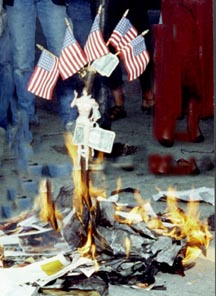
In our society it is illegal, immoral or at least disapproved behavior to burn pornography, the flag, and money because they are symbols of free expression, democracy and capitalism; but to denigrate women in words and pictures is as American as apple pie.
First Amendment Fundamentalists scoff at those who desecrate magazines or books. But, if burning a flag is speech, then burning and ripping pornography and mainstream magazines is speech too, as is pouring blood on a missile.
That Nikki Craft was arrested and incarcerated for over three weeks in Whatcom County Jail after ripping up $11.00 in Esquire magazines illustrates quite nicely that Craft’s right to symbolic, so-called free speech was superseded and limited by Chuck Robinson’s assumed private property rights.
First Amendment Fundamentalists scoff at those who desecrate magazines or books. But, if burning a flag is speech, then ripping pornography is speech too.
"Women, in case you have not noticed, have reached the end of our rope. It's time, don't you think, that you liberal white boys let go of the leash?" -- Nikki Craft
This letter is a response to "Protesters Would Impose Censorship," a guest editorial in the Bellingham Herald (June 4, 1990) by Chuck Robinson.
Next, we have this incident--the interruption of lesbian's speech outside on a city bench. Click on title for the whole story. An excerpt follows below.
Caitlin Breedlove says she and her girlfriend were forced to leave Cameron Village Shopping Center because they were kissing in public.
Raleigh, N.C. — A lesbian couple say they were forced to leave Cameron Village in Raleigh after eating lunch because they were kissing in public.
Caitlin Breedlove says she and her girlfriend were sitting on a bench with their arms around each other and had kissed briefly on the cheek when, she says, a security guard approached them, told them that “being affectionate” was “inappropriate” and asked them to leave because "no one wants to see that at Cameron Village." [THE REST OF THE STORY AND A VIDEO ON THIS STORY IS *HERE*.]
The Bastion of Great Dead White Het Male Speech, the Western Academy, is also great place to study many subjects. It is, especially, a great place to study how men's sexual violence against women gets institutionalised and protected. Not because there are Women's Studies courses on the subject any more--there used to be, in some places. But Queer Studies, Men's Studies, and Sexuality Studies have replaced studying what happens specifically to "Women". But lessons are taught after you're assaulted and try and get the administration to deal responsibly with both your own assault and the assaults of other young women on campus by young men. You could get a PhD if you study closely what happens when speaking out is met with "talk to the hand". When speech-as-feminist action meets silence-as-patriarchal institution. Click on the title below to link back.
The institutional memory of the Yale Student Body is goldfish-sized, at best, but even the freshmen have stopped feigning surprise when the administration—for the first time, headed by a female Dean—fails to take any more than spoken action on cases of sexual harassment and misogynist hate speech on campus. The recent report released by the Sexual Misconduct Committee seems like progress, but as a former Women’s Center Board member, I am skeptical that any “streamlined” solution involving that many different committees would be able to agree on so much as a meeting time. As the latest set of perpetrators explains that they too somehow failed to learn from history’s mistakes, and the Women’s Center tells us for the 1,000,000,000th time that rape is real, I (and, judging by the nearly 2,000 signatures on an online petition asking the University to denounce DKE’s actions, many other alumni) can’t help but wonder why Yale hasn’t managed to get over this hump. Because not only has Yale acutely suffered from sexual harassment, it has also produced some of the most nationally important remedies for fighting it. Looking past the narrow breadth of our time at Yale, the problems have been the same since co-education began. Nationally recognized civil, legal, and educational responses to harassment have been pioneered on this campus for at least thirty years, but Yale, despite having proffered these solutions as proof of good intentions in more than one legal situation, has yet to implement them in good faith.
Let’s begin with the bad: While the Zeta Psi incident and the Pre-Season Scouting Report were both deeply offensive, these are hardly the worst incidents of sexual harassment that the Yale community has faced. They are merely the most recent instances in a continuous string of misbehavior whose roots lie in an entrenched disregard for the dignity, personhood, and autonomy of women.
I note with interest the fact that DKE’s international directors have taken such a firm hand with this particular class of miscreants. Perhaps that is because more young, feminist Yalies work in the media now, and DKE’s shenanigans have provoked condemnation far beyond New Haven. Five years ago, we saw a very different story.
The Women’s Center participates annually in Take Back the Night (TBTN), a nationwide event to commemorate and raise awareness about sexual assault on campus. The hallmark event of TBTN is a shared circle of testimonies by survivors of rape and assault, one of the most moving and upsetting experiences a college student of any gender can have. For TBTN in 2005, the Women’s Center hung a clothesline of t-shirts emblazoned with the voices of survivors on cross-campus in the week leading up to the event. Silencing is perhaps one of the most damaging emotional weapons used against those who have been raped; accordingly, many rape survivor movements, TBTN included, take care to raise the voices of their constituency. The t-shirts gave voice to those who were not yet ready to be seen, but who yearned to be heard.
The morning after survivors and allies hung the shirts on Cross Campus, they found that several were missing. Where did they turn up? On the laughing chests of fraternity members, who saw the stories of rape written by the victims themselves as a funny fashion statement. In the Yale Daily News archives, one plaintive letter to the editor neatly illustrates the impact of the event on campus: “Clothesline T-shirt theft merited greater attention.” But nothing came of it.
Lately, students have been the perpetrators of such public crimes, but in the past, the faculty has been implicated for far worse misconduct. Few know that Yale was actually the birthplace of contemporary sexual harassment law. Yale’s official online statement against Sexual Harassment omits this interesting tidbit of legal history—perhaps because the University itself was named defendant in the landmark case in question, Alexander v. Yale.
In 1977, nine years into Yale’s co-education, sexual harassment by professors was undeniably rampant. Women would speak in knowing code, for instance, about one music teacher who was notorious for raping his tutees after lessons. “I used to play the flute,” they would say to one another in the dining halls. “I don’t anymore.”
Ann Olivarius, BR ’77, LAW ’86, SOM ’86, then a senior, had heard far too many tragic tales: Women who were afraid to go to office hours. Women who were afraid to speak up in class. Women who had turned from the talents they were most passionate about, after their instructors harassed or raped them. Women who were on the brink of suicide. Desperate women. She began collecting their stories and, with the invaluable help of a young law student named Catherine MacKinnon, LAW ’77, who would go on to birth the entire concept of sexual harassment as sex discrimination and revolutionize feminist legal theory, developed a case against Yale.
There were five plaintiffs and Olivarius was the sole woman among them who had not been the victim of an assault (a male professor who had initially filed with ∑the group did not continue to the appeal). Olivarius claimed instead that the time she had spent developing her case and trying to find relief for the other plaintiffs had negatively affected her educational career. At that time, there was no recourse for those wishing to bring a complaint against their harasser. The term “sexual harassment” was brand new and seldom used—in fact, MacKinnon’s definitive work on the subject was still an unpublished manuscript. So instead of asking for financial damages, as is customary today, the plaintiffs requested only that the University set up a means of reporting these crimes—a central grievance procedure so that information about student harassment and assault could be collected in one location, rather than dispersed among the various college deans and masters, who were often ignorant of just how widespread the problem was.
Though the women were accused of trying to expose and exploit the University, they were asking for an in-house remedy, which would allow Yale to keep its public face clean, rather than seeking a legal—and public—redress.
At first, the Yale administration was sympathetic. They had no desire to see young women get hurt, and they thought they could root out the few bad apples among the faculty and set things right. But after reading an onslaught of complaints that implicated not just one or two professors but the permissive culture of the University itself, they back-tracked. Olivarius and her co-complainants were called liars and whores. Faculty wives threatened to tamper with their academic records, and expulsion hung over their heads like a cartoon anvil. Hate-mail and death threats poured into their dorm rooms, as soon-to-be disgraced professors fought tooth and nail to keep the case from going to trial. Olivarius herself was stalked by the aforementioned serial rapist; when she finally turned to the administration official who had alerted her to this danger, he simply advised her to leave New Haven.
Olivarius, MacKinnon et al. continued to press their case. By the time it reached appeal, however, many of the plaintiffs had graduated, so the court decided they no longer had standing to sue. Their complaints were dismissed.
Yale loudly proclaimed its victory. Nevertheless, the trial and appellate courts in Alexander v. Yale agreed with the plaintiffs’ contention that sexual harassment at an educational institution could, with the right plaintiffs, constitute sex discrimination, and thus would be illegal under Title IX in federally-funded educational institutions like Yale. In later years, suits around the country established very clearly that failure to have any grievance procedure for handling sexual harassment claims could make the university liable. The line of argument used by MacKinnon eventually found full validation in the 1986 Supreme Court ruling on Meritor Savings Bank v. Vinson.
What the Alexander plaintiffs sought was an idea whose time had come, even at Yale. Though it had won the battle, the University eventually conceded the war, no doubt in part because of how grievously it had suffered in the media. A few years later, Yale established the Executive Committee’s Grievance Board as a means of hearing sexual harassment cases and providing some relief. It also endowed the Women’s Center (yes, that Women’s Center) as a place for women to find support and respite—presumably from the harassers on the faculty who remained unpunished. Schools around the country instituted similar mechanisms, and sexual harassment gained public recognition and repudiation.
Belying the University’s quiet whispers during the trial that she was flunking out, Olivarius went on to become a Rhodes Scholar. Upon her return from Oxford, she was accepted into Yale Law School and the Yale School of Management, completing both degrees in three years with high honors.
Thirty years later, an official policy against student-teacher relationships was also instituted.
Armed with this protection, women at Yale seemed primed to wage a real battle against sexual assault. But Ex-Comm has regularly failed to bring justice and, especially, attention to claims of sexual assault on campus, and fear of disciplinary repercussions certainly didn’t prevent the boys of DKE from chanting “No means yes, yes means anal” on Old Campus.
According to some, ignorance and not maliciousness are at the heart of these chants. Perhaps these boys, ordered by their fraternity elders, did not grasp the extent to which their chanting in a courtyard of young women, one in six of whom will be raped in their lifetimes, would be problematic. They did not know about Post-Traumatic Stress Disorder, or that most rapes on campus occur during a woman’s freshman year, with a spike of incidents in the very first weeks and then again, mysteriously, around the Freshman Screw. And that’s probably true. The boys screaming about rape on Old Campus definitely would not have known about any of those things, simply because Yale’s Freshman Orientation and continuing sex education are so egregiously lacking that they would not have learned them.
My freshman year, we had “Sex Signals,” in which two hyperactive actors tried to appeal to us apparently hetero-normative youths by acting out rape on stage in a “humorous” manner. We were supposed to put up a paper sign reading “Stop” when we felt rape was occurring, and it took most of the audience until she was actually screaming and fighting before any violation was perceived. Now there is the film “Relationships: Untitled,” the ugly, gutted remains of a gallant attempt to educate the student body about sexual assault and date rape which, after the administration intervened, not only fails to use the word “rape” or to show any helpful recourse for those who have been assaulted in the film, but fails to punish the rapists depicted, an accurate but hardly enlightening glimpse into the futures of an estimated 90 women in the audience.
As with sexual harassment law, Yale was once in the avant-garde of sexual education and resources. Long before the entirely student-run Yale Sex Week was founded, there was Sex and the Yale Student, an initiative that came from the top. In 1969, Yale’s medical staff realized that after 250-odd years of catering to men, they lacked the capacity to address the needs of the female anatomy. Gynecologist Dr. Philip Sarrel suggested that counseling on sexual health and relations might also be of use to the new classes of co-eds. He worked with his wife, Lorna Sarrel, to supplement basic health resources with couples counseling, family planning clinics, and a blockbuster lecture on sexuality and healthy intimacy given once a semester.
The resulting Sex and the Yale Student booklet was given to all incoming freshmen. Far from the insipid vagaries of “Relationships: Untitled,” the booklet got into the nitty-gritty of sexual politics and health in the ’70s, including an unabashed discussion of then-illegal abortion procedures and a lengthy section on consensual sex and relationships. The introduction trumpeted the benefits of this singular approach: “Among modern universities, Yale is almost unique in its creation of a special department at DUH (the Department of University Health) to deal with the sexual problems and questions of its students…so consider yourself very lucky.” The Sex and the Yale Student booklet was developed into a full-length book that sold over 100,000 copies nationwide. Garnering positive national attention from public health groups and other universities alike, Yale again found itself on the cutting edge of sexual politics.
Why has Yale skittered back from its once progressive stance on sexual education and resources? Perhaps, after the negative press Duke University received (under the leadership of former Yale Provost Richard Brodhead, BR ’68, GRD ’72) following an accusation of rape on campus in 2007, the University thought suppressing conversation and education about sexual assault would suppress the crime itself.
While the Women’s Center Board’s litigious response to the Zeta Psi incident a few years ago may seem to some to be the loudest Yale’s feminists have spoken lately, Naomi Wolf’s, YC ’83, 2004 article in New York magazine “The Silent Treatment,” not to mention Ms. Wolf’s whole career, is still one of the most famous dressing-downs of any educational institutions to date. In 2004, the Rhodes Scholar and Yale graduate wrote a feature piece describing her efforts to face the sexual assault she experienced at the hands of none other than Harold Bloom, who headlines the Humanities department to this day. Wolf had already written about her encounter with him in her critically acclaimed 1997 book, Promiscuities, albeit with the identifying details obscured. While her story is almost 30 years old and her article has been available for the better half of a decade, there are comments on it online as recent as last week—testament to the upsetting strength of her exposé.
In painstaking detail, she describes how she tried to make use of the Grievance Board process that Alexander v. Yale secured for her 25 years earlier. Courted by the Office of Development, she thought she might use her fame to gain some leverage with the administration. And she was quite wrong. Wolf tells a chilling story of self-protective denial coming from every level of the Yale administration. Stonewalled in her attempts to protect women on campus from the threat she had experienced in Bloom, she finally found the media to be her only outlet.
In the conclusion of her article, she admits a kind of ferocious defeat, stating that if another young Yalie came to her with this complaint, she could not in good conscience endorse the pathways that Olivarius and her ilk fought so hard to secure: “Wishing that [then-President of Yale] Bart Giamatti’s beautiful welcoming speech to my class about Yale’s meritocracy were really true, I would, with a heavy heart, advise that young woman, for her own protection, to get a good lawyer.”
The actions of the DKE pledges last Wednesday would have had consequences in the real world. If those statements had been made at a company, rather than a university, they would have been fired, and any woman who worked there would have had a good shot against her negligent employer as well. If these boys end up running companies, running governments, running the world, they will not be allowed to get away with such behavior, though they might fondly remember the days when they could, and dig deep for the chapter, the team, and Yale.
Of course, Yale isn’t a company. The administration often correctly reminds us that a university has other commitments, like free speech. But the law that currently ensures more safety for working women than female undergraduates (in legal theory, if not always in practice) was first conceived and tested here, in Law School classrooms and college dining halls. We should remember that the next time the administration affects a tone of injured surprise and dismay when women’s safety and dignity are compromised. Undergraduates, by nature, don’t have long memories, but institutions do. Yale knows that sexual harassment—and worse—is a campus problem, and has known it for decades. Throughout those same decades, students, faculty, and alumni have regularly suggested solutions and offered help, to no avail. Maybe in 30 years I’ll drop my kids off on Old Campus and tell them to avoid frat parties and not to trust the administration. But we can only hope that before then, much sooner in fact, Dean Mary Miller or one of her successors will finally take the lessons of Yale’s own history to heart.
Alice Buttrick is a 2010 graduate of Jonathan Edwards College. She was the Women’s Center Public Relations Coordinator in 2009.
The European University Institute (EUI) was set up in 1972 by the six founding Member States of the European Communities to provide advanced academic training to doctoral researchers and to promote research at the highest level. It opened its doors to the first researchers in 1976.
It carries out research in a European perspective in Economics, Law, History and Civilization, and the Political and Social Sciences.
Seminars and Events
The Ursula Hirschmann Annual Lecture on Gender and Europe
Date/Time
Monday 08 November 2010 17.00 - 19.00
Location
Theatre, Badia Fiesolana
Affiliation
Robert Schuman Centre for Advanced Studies, Department of Law, Department of History and Civilization
Type
Lecture
Description
Catharine A. MacKinnon
"Europe's New Sex Equality: Rape, Battering, and Trafficking" delivered by Catharine A. MacKinnon.
Prof. MacKinnon is a lawyer, teacher, writer, and activist on sex equality issues. She created the concept that sexual abuse violates equality rights, pioneering the legal claim for sexual harassment as sex discrimination. Empirical studies document that she is one of the most widely-cited legal scholars in the English language.
For organisational purposes, please register with sarah.beck@eui.eu
image which appeared in Vanity Fair magazine is from here
Bob Guccione, who died Wednesday 20 October 2010, at the age 79, was what might be termed one of several infamous U.S. pimperors, or rulers of pornography empires that trafficked in women and made exploitation and objectification into "sex" for heterosexual male consumers. He was the founder of Penthouse, a magazine of pornography (literally, the graphic depiction of 'whores') which started in England in 1965 and arrived in the U.S. in the late 1960s becoming tremendously popular and profitable through the 1970s and 1980s. It was Hugh Hefner's Playboy magazine's main rival for years. While Hefner made women into naked and less-naked Playboy Bunnies whose features were far from natural or normal, Guccione turned "his" naked or near-naked women into Penthouse Pets and perpetuated an ideology about women that held them as things to be used sexually for and by men. It is clear neither man was capable of understanding women as existing for something other than het men's sexual entertainment.
To mistake these magazines as promoting nudity and bucking puritanism or prudishness is to not understand the social and political function or effect of them at all. The values of their magazines were the values of the allegedly heterosexual male rulers of the Republican Religious Right. The values of Hefner and Guccione were fundamentally the same values of those politicians and preachers who claimed to despise pornography while they secretly used prostitutes as if they were pornography. They all wanted and worked hard to keep women down, always and perpetually under men in any number of ways, at precisely the time in Western history when feminist initiatives to free women from the conservative-to-liberal sexist shackles of patriarchal social, economic, and aesthetic imperatives was taking hold through grassroots activism. They all promote the ownership or rule of many women by one man, whether in marriage and through affairs, or through no marriage and plenty of conquests.
To dig at those roots of women's liberation, pornographers took on the feminists by calling them prudes instead of human rights activists. The public bought the lies as much as men bought the magazines selling the lies. Promotion of anti-feminist propaganda was a primary aim of pornography in the 1970s and 1980s. Nothing has changed and much has gotten worse since then.
In the mid-to-late 1980s, I remember befriending a seemingly progressive heterosexual man who hadn't yet read anything by feminists. When I suggested he read work by Andrea Dworkin a strange look came across his face. I asked him what he knew about her. He spouted off a few things, none of which were true. I then asked him, "Do you consume pornography?" He said "yes". I asked, based on the misinformation he rattled off, whether he was a fan of Penthouse. He subscribed to it. I was already familiar with Guccione's campaign to target and malign the feminists who were pointing out the racism and the misogyny of the pimping publisher's message. He didn't just subscribe to what was being sold to him. He also bought it: hook, line, and sinker. I ended our friendship when he made it clear he preferred the politics of Penthouse to treating female people with dignity.
The magazines, and the men who made them, portrayed women as subordinated things, as sex objects owned or possessed by men, as toys, dolls, and domesticated animals. Domestication of women to be of service to men is a primary goal and fundamental value of the Religious Right and Liberal Left. That the models were naked or nearly naked is what lured voyeuristic men into purchasing them, month after month, year after year. Little did they know what else was between the covers.
Those two men very subliminally and successfully sold an idea of woman along with a very political aesthetic that was also a practice--something done to real women, not non-existent as if only a fantasy. Many of the straight men who habitually looked at Playboy and Penthouse then wanted women in their lives to look (and behave) like the models in the centerfolds, to act the way the models acted. But the way models in pornography act is the way pimps direct them to be. There's no freedom from male direction, from male domination, in the aesthetic or the idea, in the practice or in the society as willed and ruled by male pimps with cameras and their male consumers of sexism. The advertising industry took its cues from the successes of both magazines while Hefner and Guccione were two billionaire pimps battling for racist pornographic supremacy inside a Western patriarchal system in which only white straight men ruled, liberally or conservatively, with one woman at his beck and call, or several.
The dehumanised images were never meant to enable women to do anything other than exist for straight men's pleasure and profit, which is the purpose to which women had been put for centuries. What Hefner and Guccione did uniquely was mass-produce the images in magazines that were then sold in neighborhood stores and through subscription across the U.S. and the world. This set up a very racist and misogynistic standard of heterosexualised white female beauty for all Western women that not even the models could maintain; that standard made male cosmetic surgeons very rich as well.
The medical malpractice of performing dangerous breast implants, other unnecessary (cosmetic) surgeries, as well as the proliferation of lethal eating disorders is traceable to the publishing practices of Hefner and Guccione. The globalisation of the terribly narrow and unattainable aesthetic is responsible for many racist and misogynistic surgeries practiced across the globe, from eye surgery on East Asian women to nose surgery on Central Asian women. And surgeries have proliferated across the Americas as well as in other regions of the world. Hefner and Guccione contributed mightily, using billions of dollars, to promote this very racist and sexist aesthetic that can only be achieved by actual women through practice: personal and medical both.
Men's contemptuous violence is always a subtext and awaits the women who refuse to comply with the standards altogether. Note the brazen vitriol unrelentingly pummeled against any feminist, any woman, who won't abide by these standards of beauty, who rejects them outright as inhumane and unbecoming. From Andrea Dworkin to Susan Boyle, if the white woman won't submit to the ritually sadistic or merely inhumane heterosexist beauty standards, she will be taunted or tormented by men, straight and gay.
For women of colour there are other specific abuses and accusations, for not being white enough, or for attempting to be white, or for being the particular ethnicity they are. Women of colour in these magazines are typically regarded as "exotic animals" to be viewed or preyed upon by white straight male procurer-hunters. In Playboy and Penthouse women of colour are dehumanised beyond recognisable personhood both by being raced and gendered "ownable". Bob Guccione, when he allowed women of colour to appear in his magazine at all, allowed "them" to appear to be available for unspeakable cruelty. His portraits of women of colour could be particularly chilling in this regard.
One of his more racist-misogynistic publishing accomplishments was profoundly violating the rights and personhood of Vanessa Williams, the first Black Miss America; after successfully humiliating her, she was forced to resign after he printed nude images of her she had posed for when in need of money. He acquired and put them in his magazine without her consent or permission--he profited off of them "handsomely" for doing something terribly ugly to her.
Guccione is also known for a Penthouse pictorial featuring East Asian women appearing to be dead, murdered, naked but wrapped almost completely in white sheets, bound with rope, and thrown off a cliff onto large jagged rocks. (White sheets and rope both signify the use of white het male supremacist power in the U.S. as blatant terrorism; the restriction of movement, binding, and murder of women across Asia is a particularly pernicious fetish of U.S. straight white men.) The models were not distinguishable from one another as unique human beings. In Guccione's pictorial narrative, they had no names or personal histories. This was an attempt by Guccione to sexxxualise violence against ethnically and nationally non-specific East Asian women by depicting them as deceased human things for primarily U.S. straight white men to masturbate to and think of as "sexy" and "hot"--even if they were, in the storyline, quite cold to the touch. Bob Guccione didn't just publish the photo spread, he profited off of their bodies being presented as murdered, wrapped, and bound (or wrapped and bound then murdered), and tossed off a cliff.
Misogyny. Racism. Heterosexism. And ageism. These are the fundaments of the values infused into each image. Ask any woman over fifty if she feels straight male-dominated society values her appearance as much as that of twenty year old females who are considered "pretty" and "sexy" by men who consume massive amounts of pornography and other media that has adopted its political aesthetics and norms--its postures, positions, lighting, fetishes of airbrushed body parts, and visual violations all normalising forms of degraded inhumanity presented and mandated as supremely erotic beauty always for women to attain, never for men. They taught straight men that having regular and routine visual access to dehumanised women was a right, an entitlement, and something to which millions of men ought to be readily accustomed. It worked. Fast forward to cameras in hotel room walls and the phenomenon of up-skirting. Men took their cues and orders from these pimps well, as soldiers do from generals.
Hefner and Guccione are uniquely each responsible for mass-producing new social manifestations of racist sexism which have become commonplace, contemporary racist misogynist practices in the West. The hands of both Hefner and Guccione have plenty of blood on them and always will; it is the life-blood drained out of women's lives as they felt increasingly physically unappealing or sexually inadequate and sought surgical solutions or employed techniques of self-starvation or bulimic bingeing and purging to try and control their bodies by destroying them.
Mass-produced pornography showed millions of men the monthly images that taught them how to desire women who cannot exist in reality and also be healthy. Playboy and Penthouse have always contained both covert and overt violence against women made to appear only as an increasingly dehumanised and degraded version of "eroticism" which is synonymous with men's right to have access--visually and otherwise to women in systems of prostitution. Pornography means the graphic depiction of 'whores'. In Hefner and Guccione's worldview, all women are potential candidates for such use and violation. If they get enough surgery and practice enough eating disorders, and allow themselves to be photographically manipulated, they may be paid to be pictured as a sex-thing for sexist straight men. But the pimps always make the profit.
As a result of the consumption of these images, plenty of women were also overtly coerced, abused, and neglected by men and a male-dominated society that found the many ways women exist to be increasingly unattractive and undesirable--ways of being that including saying "no" to men's selfish sexual demands, and objecting to men's flagrant disrespect and disregard. Some of those male abusers have been traffickers and pimps. Some of those pimps had cameras. One of the richest among them was Bob Guccione.
While he died in a hospital in Plano, Texas, he based his life and career as a pimp and publisher in New York City and so within a U.S. configuration, he might best be called The Wicked Wretch of the East. (With the anti-humanitarian Hugh Hefner being The Wicked Wretch of the West and Larry Flynt, the anti-human rights Hustler, The Wicked Wretch of the South.) Bob Guccione owned one of the largest mansions in Manhattan for years. He had a likeness of his face carved into marble there to honor himself in life while he dishonored women, portraying them as if they were dead. His magazine, primarily, is what made this white Italian-American pimp a multi-billionaire*.
When you hear his name you ought to associate it with him introducing U.S./Western society to overtly racist-misogynistic images of and practices against women, accomplished through the mass production, distribution, and consumption of his magazine. May he rot in some form of hell for all of eternity for all the crimes against humanity he committed and from which he profited. This pimp will no longer reign as emperor of anything or anyone any more. The Wicked Wretch of the East (U.S.) is dead. May we never forget the terrible things he did to womankind while he lived.
________________
*From Wikipedia:
Guccione was once listed in the Forbes 400 ranking of wealthiest people ($400 million net worth in 1982). An April 2002 New York Times article quoted Guccione as saying that Penthouse grossed $3.5 billion to $4 billion over the 30-year life of the company, with a net income of almost 500 million dollars.
image of bell hooks' book cover with photo of a young bell hooks is from here
bell hooks, Barbara Smith, Chrystos, Audre Lorde, Gloria Anzaldua, Alice Walker, Andrea Smith, Patricia Hill Collins, and many, many other radical women of color and women of color radical feminists have impressed upon me the need to center into one's analysis of oppression and resistance to it, the experiences, voices, and perspectives of women of color: Asian women and women from the Global South; Indigenous, Native, Aboriginal, First Nations, and Fourth World women; Arab, Latina, Brown, and Third World women; African American women, Black women, and women from the African Diaspora; lesbian, Two Spirit, and gender non-conforming women. Consider, please, the words of Barbara Smith here and note how her humanitarian consciousness about "women" cannot and does not remove poor women internationally and regionally from her analysis of oppressive conditions feminism exists to confront and change.
It is with a bit of trepidation that I post what follows below, as it is written by a white man. I don't experience white men, collectively or generally as being intellectually, politically, or spiritually capable of grasping the significance of the problem of marginalising women of color's voices generally, and specifically within what is called "radical feminism". This doesn't even address the problem of white men not being willing to discuss and publicly challenge white men to deal with how white men oppress all women, across sexuality, race, region, class, ethnicity, age, and levels of ability.
For me, "radical feminism" was never "white", but I know for many, many people, it is white or appears white--I know that in many collections of radical feminist or liberal feminist books, writings and analysis, theory and experience, poetry and fiction, essays and speeches by women of color are often reserved and relegated, racistly and grossly, to the "race/racism" section of the book, as if women of color can only speak about race and responding to racism, and as if women of color don't speak generally or specifically for all women. Clearly the problem with such books is that they don't often or usually conceive of "race and racism" as being a matter whites must deal with, contend with, challenge, and confront intrapsychically, interpersonally, and internationally.
From the start of my own feminist education--my education in understanding and challenging normative and unquestioned racist patriarchal modes of operation--I was reading the writings of radical feminist women of color concurrently with the writings of radical feminist white women. In most white writing, always by men and usually by women, I found an ignorance--willful or not--about the reality that whites are a politically created ethnic and social group with specific privileges and entitlements. Whites are not spokespeople for some universal notion of woman or humanity. Too often the whites I read spoke for all women. As if all women experience what white women do. As if white women experience what all women do. Needless to say--or needed to say--this is most certainly not the case. This blog here exists to challenge many things; that idea that whiteness speaks for all of humanity is one ridiculous notion I hope this blog refutes beyond resuscitation or renewal.
The idea of putting white women's (or any men's) voices above women of colors' voices is not ethically or morally or politically or spiritually or intellectually or emotionally reasonable, defensible, or tolerable. That this is systematically done by whites and by men is entirely conceivable to me--I witness it happening all the time on white men's blogs, on men of color's blogs, and, most systematically and egregiously, on white men's blogs.
But this willful or active ignorance is also reprehensible and anti-feminist, to me--it is, in a word, anti-humane. For a discussion on the importance of not centering white voices in any resistance movement, in any anti-oppression movement or effort, see this post at the Crunk Feminist Collective blog. White feminists and feminists of color have often made the point that most women who do "feminist work" don't identify as "feminist" in part because most women around the world don't speak English as a first or second language and also because among English speakers, many women don't learn the term "feminist" or what it means in their own communities. Both my grandmothers didn't know what the term meant or had very limited ideas about it meaning "bra burners" or some other white het male supremacist media-concocted notion.
I am also critical of Academic writing as it exists in my own realms of experience. Not all of it, by any means. But much of it--even most of it. I find it indulges a kind of abstraction, an intellectual pursuit not readily tied to experience, and a kind of elitism in language-use that means most people who are literate will never read it or comprehend it, not because of a lack of intelligence or what is sometimes called "sophistication", but rather because the language itself, from the start, was designed not for human consumption generally and humanely, but for the benefit of a few monetarily and materially. That said, I have written to Rad Geek congratulating him on getting this latest work published. And it ought to be noted that I don't believe all very specific forms of language--such as the language used to describe art, or the language used to describe horticultural processes, are not valuable, or ought not exist. I'm making the point that when language is used in such a way that it is mostly a very privileged and powerful minority (Western Academically educated English-speaking people) who use it, white male supremacy is likely reinforced by its usage and it warrants critique on those grounds, if not also on other grounds. And that said, I have benefited greatly from reading the work of some academics, usually those who are also activists, such as Catharine A. MacKinnon, the white, class-privileged radical feminist. I value her work greatly.
But I'm not sure what I think about this work discussed and presented below by Rad Geek. I've not read it carefully and so don't offer it up as representative, in any way, of my own thinking or values. As alluded to above, or spelled out in no uncertain terms here in the post and elsewhere on this blog, I'm skeptical about using white men's Leftist or Libertarian (or neoLiberal or neoConservative) theories to better illuminate the meaning, function, and practice of radical feminist theories and practice. But as there are so few men who take radical feminist theory seriously--even that of only white radical feminists. Rad Geek is surely among those white men who had read with intellectual and political interest and openness the work of white radical feminists. He's done so for many years. So I wanted to promote his latest work and appearances here. I'm willing to do this partly because I get how some white men will only listen to other white men, no matter the topic--even if the topic is the oppression of women (and by "women" I DON'T mean "white" women only).
What follows is from Rad Geek People's Daily. Please click on the title below to link back to his blog which has more information.
I’m pleased to say that my paper Women and the Invisible Fist: How Violence Against Women Enforces the Unwritten Law of Patriarchy[1] has been accepted for a panel at the Ninth Biennial Radical Philosophy Association Conference next month in at the University of Oregon in Eugene.
The RPA, if you’re not familiar with it, publishes Radical Philosophy Review, puts on conferences of its own, and puts on regular panels at the American Philosophical Association Eastern and Pacific Division meetings, on (engaged) radical philosophizing, critical theory, feminism, postcolonialism, academic Marxism, and the like. As RPA would have it, Founded in 1982, RPA members struggle against capitalism, racism, sexism, homophobia, disability discrimination, environmental ruin, and all other forms of domination. We also oppose substituting new forms of authoritarianism for the ones we are now fighting. … We believe that fundamental change requires broad social upheavals but also opposition to intellectual support for exploitative and dehumanizing social structures. Since this conference’s theme is Violence: Systemic, Symbolic, and Foundational, I figured that the Invisible Fist essay was apropos, and might provide a chance for some interesting Left / Left-Libertarian engagement and dialogue. Since the program committee seems to agree, I will be there representing the Molinari Institute.[2] If you happen to be around southern Cascadia next month, here’s my panel. It’d be great to see you there:
November 11th-14th
University of Oregon in Eugene, Oregon Conference Program available online
V-E: A Culture of Violence Against Women
Friday, November 12th 2010, 3:45–5:15pm
Rouge Room, Erb Memorial Union
University of Oregon, Eugene, OR
Chair: Gertrude Postl, Suffolk County Community College
Christa Hodapp, University of Kentucky. Identity Through Destruction
Charles Johnson, Molinari Institute. Women and the Invisible Fist
Jacob Held, University of Central Arkansas. Revisiting MacKinnon via Rae Langton: Pornography as Illocutionary Disablement and Civil Suits as a Means to Enfranchise the Silent Majority
I can’t speak for the others; but here’s my abstract. (If you’ve read the post with a similar title, you’ll already have a general idea; but there’ve been some changes, and like all academic enterprises, this one needs a tl;dr summary.)
When feminist theorists challenge the common dichotomies of pervasive private crimes from public policy, and of personal problems from political struggles against oppression, antifeminist critics often treat the challenge to this distinction as if it were a simple replacement of the private with a conventional understanding of the political – treating feminist analyses of patriarchy as little different from the use of conspiracy theories to explain the prevalence of male violence. I argue that, contrary to these canonical misunderstandings, the central insights of feminist analysis of patriarchal violence may be articulated with help from a surprising source – the work of radical libertarian social theorists, in particular the Austrian free-market economist Friedrich Hayek. Using philosophical analysis and critique to charitably reconstruct Susan Brownmiller’s “Myrmidon theory” of stranger-rape, as presented in Against Our Will, in light of Hayek’s conception of social order as importantly structured by emergent “spontaneous orders” which are “results of human activity but not of human design,” I argue that the dialogue provides critical terms to articulate the radical feminist critique of rape culture, while also claiming and importantly enriching the concept of “spontaneous order” as a tool for radical social critique. When this analytic reconstruction is supplemented with a discussion of recent empirical data on the pervasiveness of rape, drawn from social-science and public health literature on male violence against women, it reveals a distinctive picture that should be of prime importance both to radical feminists and to serious libertarians: a pervasive, diffuse threat of violence that constrains the liberty of women in everyday life to move and act and live as they want, but which, unlike the kinds of State violence which male radicals are accustomed to discussing — modes of domination handed down according to explicit State policies, ratified through political processes, promulgated from the top down and consciously carried out by officially appointed or deputized agents of the State — expresses itself instead in attitudes, behaviors, and coercive restrictions that are largely produced by bottom-up, decentralized forms of violence without conscious collaboration or conspiracy, sometimes in conflict with the explicit provisions of the law, in which women are battered into the social position they currently occupy as if by an invisible fist. I conclude that this unexpected convergence of Brownmiller and Hayek provides (1) a mutually illuminating dialogue on methodology in radical social theory and analytical understandings of structural violence, (2) a surprising synthesis of radical critiques of the construction of identity with radical critiques of domination through the state, and (3) an opportunity to ramify and radicalize understanding of both the feminist insight that “the personal is political,” and the Hayekian insight that society is structured by emergent orders that are “results of human activity but not of human design.”