Wednesday, March 17, 2010

U.S. White Lefty Jed Brandt on the need for Communism, the ineffectual agenda of Pres. Obama, and the failure of U.S. society to meet the needs of the vast majority of U.S. people

[image is from here]

Here's some cool info about Jed from Wikipedia. If you're wondering if he's white, here's how you know: they don't mention it.

Jed Brandt (b. Cleveland, Ohio) is an American communist.[1] His writing, photography, design and artistic work has appeared in the Indypendent, and other publications.[1] On March 1, 2010, Fox News television host Glenn Beck dedicated a segment to reporting on Brandt for a speech given at the Brecht Forum.[2][3] Brandt is a member of the Kasama Project and advocates for the formation of a new communist movement.[1]

Early life

Raised in West Virginia, Brandt relocated to Chicago. He was a founder of Youth Against Apathy, a high-school network with communists, anarchists and bohemian youth from across Northern Illinois.[1]

At age 15, he was tried on felony charges of aggravated battery (on a police officer) after "unarresting" someone from a squad of riot police in front of Chicago's main military recruiting station on the eve of a threatened US invasion of Nicaragua. Hospitalized in the arrest with multiple contusions. He was exonerated when the bite mark allegedly delivered by Brandt on the arresting officer's hand did not match his slightly crooked teeth.[1]

In 1996, Brandt, along with student leaders from across the city, formed the Student Liberation Action Movement. He was the editor of the radical CUNY-wide tabloid Spheric, and then the Hunter College Envoy, founded by the editor of the National Guardian, James Aronson. Both newspapers received awards from the Campus Alternative Journalism Project for reporting and graphic design.[1]

Jed was also briefly a member of the Revolutionary Communist Youth Brigade, where he burned an American flag of the steps of the Art Institute of Chicago, an act he said was in solidarity with all humanity and for "a world without borders."[1]

Professional life

Brandt was a staff illustrator for Vibe Magazine, and has done publication design and reporting for LeftTurn, Political Affairs, Monthly Review online, and numerous other publications. His first investigative article was written on the police torture case involving Chicago's then-Commander of Detectives John Burge, for the now-defunct Revolutionary Worker newspaper.[1]

Brandt studied philosophy and history at the City University of New York, Hunter College, with an emphasis on legal and social systems theory. He is currently in Kathmandu, Nepal, reporting on the Himalayan revolution.[1][4]
*          *          *

I am going to post two parts of one speech by Jed Brandt. I'd like you to listen carefully to him, which you are likely to do as he's white and a male who speaks English. And he's not gay. So you know, he speaks truth. And I like a lot of what he has to say. Especially about the invisibilisation of white Jewish Communist efforts in NYC that created things like rent controlled housing, co-operative housing, co-operative grocery stores, and decent living conditions for people who could not become homeless. Sound scary yet?

What I don't think is centralised sufficiently in his talk is this: the perspective and interests of Indigenous people, the place of patriarchal atrocity and male supremacy in what he's discussing, and the necessity of centralising heterosexism in his talk. He also doesn't address the fundamental problem with white male supremacist society, which is that it isn't sustainable at all. If you want to know more about that, read another white het guy, Derrick Jensen, who DOES place Indigenism, radical feminism, and "the problem of civilisation" centrally in his framework and understanding of what's fucked up about this society... the U.S. one.

But, you know, what do you expect: he is, after all, a white het guy. But he's engaging, dynamic, and radical. I like that about him. He also is not ignorant about radical feminism, although you'd never know it from what he says below. But I will post a quote of his, about Andrea Dworkin, so you get what intelligent white het men can say about their own ignorance, when they acknowledge and own it as that, and stop pretending they view the world accurately, always.

And one more thing: these two parts fly by: he talks fast and fierce and before you know it a few minutes have gone by. Listen quickly.
Part 1 of 2:


Part 2 of 2:


Now, the quote:
"All I knew about Dworkin was that she hated men, hated sex, wanted to help the government censor porn and hated my dick, which I so very much loved. In other words, I knew nothing of Andrea Dworkin except what others had said about her. That she was ugly and bitter, the personification of female resentment" -- Jed Brandt

That quote is from this short piece (below), reflecting on the work of Andrea Dworkin in the days following her death, almost five years ago now. Clicking on either the name, the date, the category, or "Email this article", just a few lines down, will link you back to the original source, The Indypendent.

‘I’m a Radical Feminist, Not the Fun Kind’: Andrea Dworkin, Philosopher, Dies at 58

By Jed Brandt
From the April 20, 2005 issue | Posted in Culture | Email this article
 
I only met Andrea Dworkin once, in passing, at a Brooklyn cafe where I was parsing the Village Voice job listings and halfreading a Don DeLillo book that caught her eye. She was a large woman, powerful in presence even when seated. She had the same wild, Jewish hair and piercing, yet gentle eyes as my mother. Two smart women of the generation that broke out with what they used to call Women’s Liberation, they had learned not to fear their own intelligence no matter who they scared. All I knew about Dworkin was that she hated men, hated sex, wanted to help the government censor porn and hated my dick, which I so very much loved. In other words, I knew nothing of Andrea Dworkin except what others had said about her. That she was ugly and bitter, the personification of female resentment.

“DeLillo always almost gets it, enough anyway to keep me hoping his next book will finally deliver,” she said. I was reading Mao II, and this was before DeLillo finally did bring it home with Underworld, and so I learned that whatever ‘70s time warp she was stuck in, she certainly knew how to read. And then, to my surprise, I learned that she had a male partner, a slight, blond-haired man she introduced as John, who finally joined her before I returned to looking at my book, thinking, “What a hypocrite! She hates men and then sits down to coffee with some guy.” They held hands across the little table, talking easy and light with each other on an average weeknight in Park Slope 12 years ago.

“I am a radical feminist,” she said of herself, “not the fun kind.” Still a man-child when I met her, I hadn’t learned of the real power even ordinary men have when it comes to women. I was born in the early ‘70s, a part of the first generation to come of age after the sexual revolution – used to it, taking it for granted. We were all friends, boys and girls, and without children of our own, or serious jobs and responsibilities, “the patriarchy” seemed little more than some boogieman that timid, out-of-step feminists used to justify their own existence. And then, one by one through our early 20s, I watched as my lovers and friends sold themselves. They stripped or whored to get through school or just to buy dope. They settled for baby-daddies not worth their time, got beaten and stayed with their abusers because, “That’s just how guys are, it’s more complicated than it looks,” as if a bruise could be anything but what it is. I watched my sisters become what men wanted them to be. Men just like me. Because men can. Because decades after women’s liberation, everyday equality is still just a specter. I came to see why Andrea Dworkin is so feared she has to be maligned. I had to become a man to really read her.

Dworkin never said that all sex was rape, even if she saw how the cock is a weapon. She never, no matter how easily her provocations could be misread, claimed that men and women could not love each other. Care for each other. Dream out loud of a world where we don’t know each other by how we hurt each other. She was a philosopher. She didn’t smile when she wrote how women are hurt, beaten, raped. By men who love them. By men who hate them. By men. She wrote of sex without the giggle or sly nod women so often use to put men, and themselves, at ease. She left no easy out for the decent man to say, “Yes, all this rape is terrible – but not me.”

Uninterested in pleasantries, she was intolerant of women’s pain. She did not hate the victims of oppression, but the acts so mundane that no one had seen fit to mention them. The breaking of wives, the training of boys to “become men,” the male right to buy women’s bodies and painted smiles, pornography as “men possessing women.” When Hannah Arendt generalized the banality of Nazi evil, she was applauded. Dworkin applied the same principle to our intimate lives and was spit on. For hating rape they said she hated sex.

Gloria Steinem said, “Every century, there are a handful of writers who help the human race to evolve. Andrea is one of them.” Let that be her epitaph, for from her we can learn the measure of our own progress. Flawed, prone to over-extending simple truths, she was a giant.

For nine years, The Indypendent has printed truth in the face of power. With political and economic systems faltering, there is an opportunity for real change from the bottom up. But this means having a vibrant independent media. Consider supporting The Indypendent as a monthly sustainer, donating as little as $5 a month. Please visit indypendent.org/donate.

The Crime of Carving Swastikas in the Skin of a Woman is not only Racist and Anti-Semitic

[image is from here]

It's also a pornographically misogynistic violation of a female human being. The swastika, and Nazism generally, is a genre of pornography, which should surprise no one, given that all pornography is fascistic to women as a class of human beings subordinated internationally to men who deem themselves superior to women. From Wikipedia, we find out this:
Adult films also exploited Nazi scenarios in a string of sadomasochistic "roughie" pornographic films in the '70s and early '80s. Examples include the Mitchell brothers' Hot Nazis, Nazi Love Island with John Holmes and Seka, and Hitler's Harlot. One of the last entries, Stalag 69 (1982), starred Angelique Pettyjohn as an Ilsa-type SS officer. The story was largely a remake of Love Camp 7, bringing the cycle back to its origins. The genre remained mostly dormant for the next two decades. In 2006, Mood Pictures, a Hungarian producer of S&M films, released Gestapo, Gestapo 2, and Dr. Mengele in 2008, all of which are set in a Nazi prison camp and pay homage to Ilsa and the Italian exploitation films.
Neo-Nazi groups (anti-feminist, anti-immigration, anti-queer, and pro-white and pro-Fascistic European Nationalism) are strengthening across Europe and their core is patriarchal racism, which you'd never know from reports like this one by Phil Dickens from an anarchist site, Property is Theft.

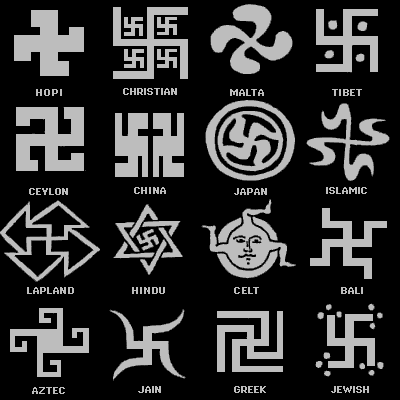
This is not a specifically a "Greek" problem, but Greece (like other European States and white het male-dominated States, such as Australia, the U.S. and the UK), is struggling in many ways, with great economic instability and grossly racist elements. This video describes some of the current climate, but also does some racist things, like calling fascists "primitive" and using the Mayan, Kuna (Panama), and Hopi, West, South, Southeast, and East Asian symbol (in Hinduism, Jainism, and Buddhism, for example; in Sanskrit, Japanese, Chinese languages) to mean the Nazi swastika, as if one is the same as the other. So there's a kind of racism against Indigenous peoples that inheres in the way this story is being told. It also has roots in pre-Christian Europe, including parts of Scandinavia, Eastern Europe, Germany, and Greece, specifically.

Generally, if not conclusively, the Nazi swastika can be identified and distinguished by color combination and by the fact that the uncriss-crossed elements can read as "SS", and the symbol is tilted on its edge. In many other societies, it reads "ZZ" to Anglocise it, and lies flat on one of its four sides.

For more (and in some cases repetitive) history on the culturally diverse and distinguishing features of many of these symbols, most of which do not refer to anything fascistic, but some of which due mean "purity", see this, from *here*:
The swastika is an equilateral cross with arms bent at right angles, all in the same direction, usually the right, or clockwise. The swastika is a symbol of prosperity and good fortune and is widely dispersed in both the ancient and modern world. It originally represented the revolving sun, fire, or life. The word swastika is derived from the Sanskrit swastika which means, "conducive to well- being". The swastika was widely utilized in ancient Mesopotamian coinage as well as appearing in early Christian and Byzantium art, where it was known as the gammadion cross. The swastika also appeared in South and Central America, widely used in Mayan art during that time period.

In North America, the swastika was a symbol used by the Navajos. The swastika still continues today to be an extensively used sign in Buddhism, Jainism, and Hinduism. In Buddhism, a swastika represents resignation. In Jainism, it delineates their seventh saint, and the four arms are also used to remind the worshiper of the four possible places of rebirth; the animal or plant world, in Hell, on Earth, or in the spirit world. To Hindus, the swastika with the arms bent to the left is called the sathio or sauvastika, which symbolizes night, magic, purity, and the destructive goddess Kali. In both Hinduism and Jainism, the swastika or sathio is used to mark the opening pages or their account books, thresholds, doors, and offerings.

The swastika was a symbol for the [predominantly Indian/Iranian, but also European/Iranian] Aryan people, a name which, in Sanskrit means "noble". The Aryans were a group of people who settled in Iran and Northern India. They believed themselves to be a pure race, superior to the other surrounding cultures. When the Germans looked for a symbol, they looked for a symbol which represented the purity which they believed they contained. The Nazis regarded themselves as "Aryans" and tried to steal the accomplishments of these pre-historic people.

In Nazi Germany, the swastika with its arms turned clockwise became the national symbol. In 1910, a poet and nationalist Guido von List suggested that the swastika as a symbol for all anti-Semitic organizations. When the National Socialist Party was formed in 1919, it adopted the ancient symbol, the swastika, giving it the worst meaning possible, destroying the good symbolism which the swastika had held for thousands of years prior.

In 1935, the black swastika on a white circle with a crimson background became the national symbol of Germany. The major difference between the Nazi swastika and the ancient symbol of many different cultures, is that the Nazi swastika is at a slant, while the ancient swastika is rested flat.
What follows is from *here*, and was originally posted on 9 March 2010 ECD.

Anti-Racism Rally

Via Kathimerini
Residents of Hania as well as teachers and students staged a demonstration in the Cretan port yesterday to protest a string of racist attacks in the area in recent weeks, culminating at the end of last month in an attack on a teacher who had swastikas carved into her skin. “We are marching today to remind young people that their grandfathers fought so that the swastika would not fly on flags in the Cretan sky,” a protest organizer said. Police said they believe the perpetrators had targeted the 27-year-old teacher because she had been offering Greek language lessons to the children of immigrants.
*          *          *
Finally, here is a video on racist, anti-immigrant fascistic activist groups in Greece, with the wrong symbol representing the Nazi swastika. It tells some of the recent history of this activism:

Lee Maracle on the Need and Necessity of Ontario First Nations Public Libraries

With apologies for it being too wide for this blog, you can see the whole original *here* on YouTube.

A Radical Profeminist Alert: Lee Maracle is more than a benchwarmer, and please tell that to the men who need to know it

 [photograph of Indigenist feminist activist and AUTHOR Lee Maracle is from here]

What follows is a cross post from *here*.

Indigenous Politics, Web Exclusive

Are Aboriginal women and women of colour benchwarmers?

“They’re going to use Lee Maracle as a backup if Shawn Brant can’t make it,” said the insider of a coalition that aims to educate people on what they believe is an apartheid state in West Asia the Middle East.

This is one example of a larger problem within activist circles: Aboriginal women and women of colour given the backseat to men.

Years ago Mohawk woman Kahentinetha Horn was to be a secondary speaker to a keynote named AngryArab. Little did organizers know that Horn does not believe in being second to anyone, she stole the show. Being a “backup” is not in Horn’s interest or nature. A “backup” for Horn is more likely to be an extra clip for a Glock 9mm, not playing second fiddle to a blogger. So, Horn tooted, and AngryArab, well, remained angry.

But not all women are bold and confrontational like Horn, nor should they have to be.

The question is why do many activist circles preach equity while practicing sexism, misogyny, and what believe is racism? If women are given the forefront it is usually a white woman like Naomi Klein (or in terms of the literature world, Margaret Atwood).

In the past decade Indigenous men have dominated some of the big speaking circles here in Toronto. In the early 2000s the flavour of the month was Ward Churchill: Cherokee, controversial, well read and spoken. Problem is, Churchill says the same thing every time he talks! This writer has seen him speak on three separate occasions for different organizers and events. Churchill gets paid ridiculous amounts for a recycled speech.

The next guy gained popularity outside of the Indigenous community via wrongful incarceration—Bob Lovelace. Now we have Shawn Brant, CN Rail’s worst nightmare, and the new Indian tokenized by the left. Both have done great anti-poverty and land rights work and as a result have become celebrities for white and non-Indigenous activists.

So, we have three men who are heterosexual, able bodied, and have light skinned privilege, many say white privilege. And in the last example, to this writer’s knowledge, an Indigenous woman of colour is only good enough to be his “backup”.

What makes these men so special to white and non-Indigenous activists?

One is an outspoken and vilified professor who has written important books and was a member of the famed American Indian Movement. It is the recent news making actions of the second, doing time and being treated unjustly by cops and government (most of my friends and I should be speaking then, as well as the members of the fastest growing prison population worldwide—women of colour), and the third, laying a school bus across train tracks. These acts have led all three to be tokenized in activist circles.

It seems like gangster ideologies have been adopted by today’s activists. Doing time and holding standoffs with cops has earned certain people, usually men, street cred. Much good work by women that does not involve conflict or media attention is overlooked.

Lets look at some of the many things one Indigenous woman of colour, Lee Maracle (feminist, activist, writer, mentor, ally, mother, grandmother, now reduced to being a benchwarmer), has done over the last forty-five years:
  1. is a Life Giver who brought three Aboriginal children to this world, without Aboriginal women there are no Aboriginal people
  2. helped save the Barrie Native Friendship Centre from closing down in the 1990s, this giving Aboriginal folk a place to meet and spend time in a mostly white town
  3. paved the way and opened doors for many Indigenous writers and writers of colour
  4. has counseled countless survivors of violence and trauma
  5. is one of the few brown, female faces in the white dominated worlds of literature and academia (her book “I Am Woman” is taught everywhere)
  6. has taught many people how to read and write, this in turn combating one crucial aspect of the colonial prison pipeline—illiteracy
  7. has helped change laws that were oppressive to Aboriginal people and people of colour
  8. constantly makes links with different peoples and places in terms of colonialism
  9. supports events that effect people other than just Aboriginal folk: International Women’s Day, Yearly March Against Child Abuse, December 6th Vigil etc.
  10. is a vocal supporter of oppressed peoples worldwide, for example:
Song to a Palestinian Child
I hear a voice calling from a place far away
The voice of a child very much like my own
of green grass and rich soil in Palestine.
Bombs crash about her leveling her home
Clutching an olive branch she raises a defiant fist
of deep roots and copper sun in Palestine.
I see a child rising from a place far away
In one hand an olive branch in the other a gun
of much sweat and red blood in Palestine.
I hear your calling me. Raising my banner high
(Victory), victory, to Palestine I answer in kind
of humble tears my salute to Palestine.
The last ‘action’ (the beloved word of the activist left) Maracle did was hold and console a crying female relative of a murdered woman. Tears drenched Maracle’s coat as many names of the over 500 Missing and Murdered Aboriginal women in Canada were read on February 14, 2010 in front of police headquarters in Toronto. To activist groups, this act of solidarity, and the incomplete list above, does not compare to yelling the same thing at every speaking engagement or stopping a train in front of television cameras. Maracle’s actions have not made front page, or the six-o’clock, news and have not seen her arrested as of late; therefore, she is only good enough to be a backup.

Actions deemed relevant by activist communities are macho and usually done by men.

Have activist groups adopted practices they claim to fight? You would think that groups who claim to be anti-oppressive would practice gender equity. And in terms of Indigenous solidarity (something that activists yell every chance they get), does tokenizing one gender and silencing another equate solidarity?

This writer asked Maracle why she accepts last minute requests for talks (recently an MC gig) when she sometimes knows she is being used as a fill in for absent men.

“If I didn’t I’d never get the stage,” said Maracle.

Sad.
Unjust.
Corrupt!

Again, Maracle is one example of many in this problematic and oppressive practice done by activist groups here in Toronto, and elsewhere I am sure.

Is there a shortage of Aboriginal women and women of colour speakers? A few names come to mind:
Jan Longboat
Afua Cooper
Marilyn Dumont
Jacqui Alexander
Ana Castillo
Chrystos
Christine Welsh
Tracey Deer
Deborah McGregor
Rita Wong
Sunera Thobani
Njoki Wane
Sandra Cisneros
Yasmin Jiwani
Dionne Brand
Pauline Shirt

It would be an honour for this writer to one day be a backup for Lee Maracle, even if it meant keeping a seat warm for her on a bus parked across train tracks.
  • Jorge Antonio Vallejos is a mixed race (Indigenous/Spanish/Arab), Toronto based, poet, essayist and journalist. His writing has appeared in COLORLINES, XTRA!, THIS Magazine, Rabble, Anishinabek News, Toronto Star, The Kenyon Review, and is forthcoming in Descant and Ruptures: Anti-colonial Feminist Theorizing. Jorge can be reached at condorsview@yahoo.ca

4 comments

  • yes…and why is it more likely that a non-native professor get tenure for teaching Native studies / postcolonial theory -rather than a Native
    and why is it ok for the artist ORLAN to have /exhibit an Indian identity-and not ok for me?
    and why is it, that most full tenured profs teaching African American studies are in fact not African themselves when-this would be equal to a man, teaching feminist theory
    answer=they continue to benefit off of the oppressed- by teaching /writing/getting grants to “research” about oppression-to the complete exclusion of the oppressed.
    we do need EVERYONE to teach these subjects-agreed-but not to the exclusion of the real represented we need the women to speak, and teach truths of lives lived under oppression so that we can break the cycle and continue in our responsibilities of carrying culture forwards and protecting land and Sovereignty
    #1. Posted by tannis nielsen in toronto on March 16th 2010 at 2:25pm 

  • It’s also about tactics and which ones we think are more important.
    #2. Posted by Rhonda in Toronto on March 16th 2010 at 2:44pm 

  • Thank you for this really important article Jorge.
    As someone who has personally been active in all types of solidarity and activist work, this has been a huge issue for me, that not enough people are thinking about.
    The blatant tokenization of Indigenous women and peoples in general is disgusting, and happens in so many organizations and circles, when it’s convenient for them.
    To further this, the appropriation of Indigenous traditions and practices by lefties and “anarchists” is also something that people aren’t talking about, and we should.
    Again, thanks for the article, hope to see more people engage with it, and more written on this issue.
    #3. Posted by Aruna Boodram on March 16th 2010 at 4:53pm

  • Thanks for the great article, Jorge. I remember asking Lee Maracle for help and advice and she was just incredible. She talked about her struggles and what she wants to see for aborginal women and women of colour like it was something she saw everyday-and that really gave me a lot of perspective about my own experiences. I remember one thing she said that really stood out, that when it comes to feminism, the dominant society follows these “recipes” that stem from privileged academic backgrounds on how to make change and I realize that it’s really problematic not just for women of colour to employ, but also undermines interactions between the two groups because the dominant society is content and coming face to face with their privledge is what could be halting actual change.
    Hopefully there will be more discourses on issues on this very important topic. Thank you Jorge and if you read this, thank you again Lee Maracle.
    #4. Posted by Mariette Lee in toronto on March 16th 2010 at 10:43pm

For Indigenous Peoples, a Choice: Following Coloniser State Rules, or International Human Rights Standards


[image is from here]

What follows is a cross post from *here*:

Fourth World Eye
An Online Daily Journal of the Center for World Indigenous Studies.

Rights of Indigenous Peoples
The extension of citizenship rights to peoples that have been dispossessed and subsumed by the very States that are granting these rights is simply a form of internal colonialism. Indeed, citizenship is often associated with nation building and state legitimacy and, in fact, makes no sense outside of the framework of the nation-state. Human rights on the other hand are extra-governmental and have been traditionally used to counteract the repressive capacity of states. It is for this reason that indigenous peoples have accepted the UN Declaration on the Rights of Indigenous Peoples as an articulation of their rights, as opposed to the citizenship rights imposed on them by the settler state.
–Damien Short Reconciliation, Assimilation, and the Indigenous Peoples of Australia

Monday, March 15, 2010

Wishing Enough WAS Enough: A Message for Men to STOP the Misogyny!

THANK YOU, to Ms. Phylicia Oppelt for what follows. The article is from *here*.

Malema: 'Enough is enough'

Judge nails youth league leader over sexist outbursts

Mar 15, 2010 10:51 PM | By Phylicia Oppelt


Phylicia Oppelt: Today, I write this column with the faintest glimmer of hope that things are not all that bad.


Phylicia Oppelt
Phylicia Oppelt
quote Hatred of and violence against women is unacceptable quote

I write it not because there has been a massive shift in South Africa and our leaders toward the realisation of our Constitution.

I write it not because the service delivery protests are over and that all children are safe.
I write it because a woman judge stood up and said "enough is enough".

She didn't say it in those words, but her judgment in the equality court said it for her.

Yesterday, Magistrate Colleen Collis fined ANC Youth League president and South Africa's chief rabble-rouser Julius Malema R50000 and ordered that he issue an apology for comments made last January when he spoke of President Jacob Zuma's rape accuser.

Malema said: "When a woman didn't enjoy it, she leaves early in the morning. Those who had a nice time will wait until the sun comes out, request breakfast and ask for taxi money."

That hope was strengthened with the knowledge that the person who took Malema to court is African and male.

Moreover, it is someone who found himself called upon to do what the elders of the ANC (for all of their historical "revolutionary" zeal and bravery) have not the courage to do - to publicly contradict and go against Malema.

Mbuyiselo Botha's court action speaks of activism, of action. It speaks of someone not cowed by the invective spewed by Malema.

Instead, Botha's action says, we will hold you accountable; we will make you accept responsibility for holding others in contempt.

But we need more than one court action and we need more than one man's convictions that hatred of and violence against women is unacceptable.

In 1983, late feminist Andrea Dworkin asked for a [twenty-]four-hour truce during which there was no rape.

She spoke to a room of mainly politically active men when she asked this, saying that there was nothing difficult or complex about the reason why men rape.

They raped, Dworkin said, because of the kind of power that men have over women.

"That power is real, concrete, exercised from one body to another body, exercised by someone who feels he has a right to exercise it, exercised in public and exercised in private. It is the sum and substance of women's oppression."

She also said women were no longer going to do men's work, helping them believe in their own humanity. "We cannot do it anymore. We have tried."

Malema's outbursts against women prove her point. When he calls ID leader Patricia de Lille "not a real woman" or the DA's Helen Zille a "little girl", he understands full well the power relations in our country; that as a man, however intellectually bereft, he can get away with it.

His behaviour makes a mockery of the leader for whom he sings, dances and insults.

In this context, of having a chief supporter who is a woman-hater, how can I take my president seriously when he speaks out against rape?

How much credence must I lend to his statement that the men who raped the female paramedic last week in Roodepoort's Durban Deep - after she and her colleagues went to treat a two-year-old burn victim - are animals?

How must I deal with President Jacob Zuma's statement: "The government is distressed. These people are animals. All you need is a bit of fur and these people are animals"?

How can I be sure my president is listening to the distress that I and my fellow countrywomen suffer when we think of our personal safety and the reality that we might end up victims of rape?

My hope in Botha's courage will be replaced with fear and trepidation tonight when I approach my driveway, peering across the steering wheel into the dark recesses between houses to ensure no one is waiting who wants to do harm.

I have learnt to keep the car's engine running until the automated gate has shut and I'm sure no one has followed me in.

Who else will stand up for us in our moments of fear?

Botha's courage might have influenced a court to pronounce Malema culpable of hate speech against women - but Malema's pronouncements are able to convert young men into haters of women.

And it is in that realisation that my hope dies a rapid death.

[Julian's note: Here is that speech.]

Radical Feminist Audre Lorde's Famous Essay: "The Master's Tools Will Never Dismantle the Master's House"

[graphic image of Audre Lorde is from here]

From Sister Outsider: Essays and Speeches, The Crossing Press Feminist Series (1984)

I found a copy of it *here*.

The Master's Tools Will Never Dismantle the Master's House

by Audre Lorde

I agreed to take part in a New York University Institute for the Humanities conference a year ago, with the understanding that I would be commenting upon papers dealing with the role of difference within the lives of American women: difference of race, sexuality, class, and age. The absence of these considerations weakens any feminist discussion of the personal and the political.

It is a particular academic arrogance to assume any discussion of feminist theory without examining our many differences, and without a significant input from poor women, Black and Third World women, and lesbians. And yet, I stand here as a Black lesbian feminist, having been invited to comment within the only panel at this conference where the input of Black feminists and lesbians is represented. What this says about the vision of this conference is sad, in a country where racism, sexism, and homophobia are inseparable. To read this program is to assume that lesbian and Black women have nothing to say about existentialism, the erotic, women's culture and silence, developing feminist theory, or heterosexuality and power. And what does it mean in personal and political terms when even the two Black women who did present here were literally found at the last hour? What does it mean when the tools of a racist patriarchy are used to examine the fruits of that same patriarchy? It means that only the most narrow perimeters of change are possible and allowable.

The absence of any consideration of lesbian consciousness or the consciousness of Third World women leaves a serious gap within this conference and within the papers presented here. For example, in a paper on material relationships between women, I was conscious of an either/or model of nurturing which totally dismissed my knowledge as a Black lesbian. In this paper there was no examination of mutuality between women, no systems of shared support, no interdependence as exists between lesbians and women-identified women. Yet it is only in the patriarchal model of nurturance that women "who attempt to emancipate themselves pay perhaps too high a price for the results," as this paper states.

For women, the need and desire to nurture each other is not pathological but redemptive, and it is within that knowledge that our real power is rediscovered. It is this real connection which is so feared by a patriarchal world. Only within a patriarchal structure is maternity the only social power open to women.

Interdependency between women is the way to a freedom which allows the I to be, not in order to be used, but in order to be creative. This is a difference between the passive be and the active being.

Advocating the mere tolerance of difference between women is the grossest reformism. It is a total denial of the creative function of difference in our lives. Difference must be not merely tolerated, but seen as a fund of necessary polarities between which our creativity can spark like a dialectic. Only then does the necessity for interdependency become unthreatening. Only within that interdependency of different strengths, acknowledged and equal, can the power to seek new ways of being in the world generate, as well as the courage and sustenance to act where there are no charters.

Within the interdependence of mutual (nondominant) differences lies that security which enables us to descend into the chaos of knowledge and return with true visions of our future, along with the concomitant power to effect those changes which can bring that future into being. Difference is that raw and powerful connection from which our personal power is forged.

As women, we have been taught either to ignore our differences, or to view them as causes for separation and suspicion rather than as forces for change. Without community there is no liberation, only the most vulnerable and temporary armistice between an individual and her oppression. But community must not mean a shedding of our differences, nor the pathetic pretense that these differences do not exist.

Those of us who stand outside the circle of this society's definition of acceptable women; those of us who have been forged in the crucibles of difference -- those of us who are poor, who are lesbians, who are Black, who are older -- know that survival is not an academic skill. It is learning how to stand alone, unpopular and sometimes reviled, and how to make common cause with those others identified as outside the structures in order to define and seek a world in which we can all flourish. It is learning how to take our differences and make them strengths. For the master's tools will never dismantle the master's house. They may allow us temporarily to beat him at his own game, but they will never enable us to bring about genuine change. And this fact is only threatening to those women who still define the master's house as their only source of support.

Poor women and women of Color know there is a difference between the daily manifestations of marital slavery and prostitution because it is our daughters who line 42nd Street. If white American feminist theory need not deal with the differences between us, and the resulting difference in our oppressions, then how do you deal with the fact that the women who clean your houses and tend your children while you attend conferences on feminist theory are, for the most part, poor women and women of Color? What is the theory behind racist feminism?

In a world of possibility for us all, our personal visions help lay the groundwork for political action. The failure of academic feminists to recognize difference as a crucial strength is a failure to reach beyond the first patriarchal lesson. In our world, divide and conquer must become define and empower.

Why weren't other women of Color found to participate in this conference? Why were two phone calls to me considered a consultation? Am I the only possible source of names of Black feminists? And although the Black panelist's paper ends on an important and powerful connection of love between women, what about interracial cooperation between feminists who don't love each other?

In academic feminist circles, the answer to these questions is often, "We did not know who to ask." But that is the same evasion of responsibility, the same cop-out, that keeps Black women's art out of women's exhibitions, Black women's work out of most feminist publications except for the occasional "Special Third World Women's Issue," and Black women's texts off your reading lists. But as Adrienne Rich pointed out in a recent talk, white feminists have educated themselves about such an enormous amount over the past ten years, how come you haven't also educated yourselves about Black women and the differences between us -- white and Black -- when it is key to our survival as a movement?

Women of today are still being called upon to stretch across the gap of male ignorance and to educate men as to our existence and our needs. This is an old and primary tool of all oppressors to keep the oppressed occupied with the master's concerns. Now we hear that it is the task of women of Color to educate white women -- in the face of tremendous resistance -- as to our existence, our differences, our relative roles in our joint survival. This is a diversion of energies and a tragic repetition of racist patriarchal thought.

Simone de Beauvoir once said: "It is in the knowledge of the genuine conditions of our lives that we must draw our strength to live and our reasons for acting."

Racism and homophobia are real conditions of all our lives in this place and time. I urge each one of us here to reach down into that deep place of knowledge inside herself and touch that terror and loathing of any difference that lives there. See whose face it wears. Then the personal as the political can begin to illuminate all our choices.